The Internet of Things landscape is changing how businesses work in Europe. France is leading this digital change. We’ve seen a big increase in connected devices and smart solutions.
These changes are making a big impact in many areas, from making things to helping people stay healthy. This guide gives you key information about France’s exciting tech world.
France is a top tech spot in Europe, thanks to strong government support for digital growth. There’s also a lot of money going into new tech projects. This makes it a great time for UK businesses and investors to get involved.
In this guide, we’ll look at the IoT market in detail. We’ll cover how to size the market, different uses in sectors, rules, and how to put things into practice. You’ll learn how to set up a business, understand what you need, and deal with the tech world’s challenges.
By the end, you’ll know how to take advantage of new trends. You’ll be ready to make smart choices about entering this promising European market.
Understanding What the Internet of Things Means for the French Market
France’s Internet of Things (IoT) is a mix of cutting-edge tech, government support, and diverse uses. This makes France stand out in Europe. The French technology market has grown into a complex system. It drives efficiency in industries and makes life easier for consumers.
This change makes France a leader in innovation and a testing ground for IoT solutions. It shows how France is at the forefront of IoT in various sectors.
The IoT in France is more than just smart devices. It’s a network that supports the economy, sustainability, and digital sovereignty. Knowing this is key for any company looking to get into the French IoT market.
The Fundamentals of Connected Technology in France
In France, IoT solutions include a wide range of sensors, devices, and analytics. These work together to collect and share data without human help. This is what the Internet of Things means in France.
The French government’s France 2030 investment programme focuses on IoT. It plans to spend €54 billion on digital transformation, with IoT at the top of the list. This shows how important IoT is to France’s future.
The IoT in France works on three main layers. The first layer is the perception layer, where connected devices France uses gather data. The second layer is the network layer, which includes 5G networks and other ways to send information. The third layer is the application layer, where data is processed and insights are given to users.
IoT is used in many ways in France. Factories use it for predictive maintenance. Farms use it for precision farming. Cities use it for better lighting and traffic management. Hospitals use it for remote patient monitoring.
France also focuses on keeping data safe and private. Companies follow GDPR rules and keep data in Europe. This makes France a good place for IoT businesses to focus on privacy.
Strategic Advantages That Position France as an IoT Leader
France is a great place for IoT businesses and investors. It has advanced tech, a strong economy, and a culture that supports innovation. These factors make France a good place for IoT.
France has a top-notch telecommunications network. It has almost all homes covered by broadband and is rolling out 5G fast. This network is key for IoT to work well.
France also has a lot of skilled workers. Its schools and universities produce many graduates in tech and data science. This talent helps both big tech companies and new startups.
France’s economy is diverse, which means IoT is used in many areas. This reduces risk and offers many chances for businesses to grow. It’s a good place for IoT to thrive.
| Strategic Factor | French Market Characteristic | Opportunity Created | Relevant Sectors |
|---|---|---|---|
| Government Investment | €54 billion France 2030 programme with IoT priority status | Public procurement contracts and innovation funding | Smart cities, healthcare, industrial automation |
| Geographic Position | Gateway to 450 million European consumers with strong transport links | Regional headquarters location and distribution hub | Logistics, retail, cross-border services |
| Innovation Ecosystem | Station F (world’s largest startup campus), 25 French Tech capitals | Collaboration opportunities and accelerator programmes | All sectors, particular B2B SaaS and hardware |
| Consumer Adoption | 68% smartphone penetration, growing smart home device ownership | B2C market expansion for connected consumer products | Smart home, wearables, energy management |
France’s startup scene has grown a lot. Paris is one of Europe’s top tech hubs. Lyon, Toulouse, and Grenoble have their own tech clusters. Lyon focuses on health tech, Toulouse on industrial IoT, and Grenoble on environmental monitoring.
The public sector in France is pushing IoT adoption. Cities are using IoT to solve urban problems. These projects help prove the value of IoT and can help businesses grow.
France is a key gateway to Europe for IoT businesses. Companies here can reach 450 million consumers in the EU. Its location, transport, and culture make it easy to expand into Europe.
French people are getting more comfortable with connected devices France offers. 73% of households want to buy smart home tech in the next two years. This shows a big chance for B2C IoT in France.
The rules in France for IoT are strict but clear. It follows GDPR and has specific rules for IoT. This makes France a safe place for IoT businesses to focus on privacy.
France is a mix of a developed market and a growing one. It has the stability of a developed market and the growth of a new one. This makes it attractive for investors and businesses looking to grow.
How to Research and Assess the Current France IoT Market Size
Before diving into the French IoT industry, we need to gather accurate market data. This helps us spot growth chances, understand the competition, and make smart investment choices. We look at credible sources, interpret financial forecasts, and see France’s place in Europe.
Market research must be done carefully to avoid mistakes. The IoT market France is always changing, so we need up-to-date and reliable data for planning.
Identify Reliable Market Data Sources
Finding trustworthy sources for the French IoT industry is our first step. Quality and credibility vary among different providers.
We start with French tech associations like the Alliance Française des Industries du Numérique (AFNUM). They publish reports on tech trends. These reports often have data that bigger studies miss.
International firms like IDC France and Gartner also offer valuable insights. IDC France updates on IoT spending every quarter. Gartner forecasts emerging tech for five years ahead.
Government agencies like INSEE are also key. They publish data on tech investments and digital infrastructure. Their reports are valuable for a fair view.
Telecom providers like Orange Business Services and Bouygues Telecom share insights too. They report on IoT growth in various sectors. Their data shows real deployment rates, not just predictions.
Industry associations also provide specific insights. For example, the French Federation of Electronics and Communications analyses connected device markets. Checking different sources helps us confirm figures and spot trends.
Analyse Market Valuation and Growth Rates
After collecting data, we need to understand market valuations and growth forecasts. Knowing how these are calculated helps us spot real opportunities in the French IoT industry.
Market valuations include device sales, platform and software revenues, and connectivity subscriptions. We look at each part separately. This helps us see the whole picture.
When looking at growth rates, we must be careful. A 15% CAGR over five years means different growth depending on the starting size. Always check the base year when comparing forecasts.
Growth rates vary by sector. Consumer IoT might grow 20% a year, while industrial IoT grows 12%. These differences help us plan our business strategy.
We should use a simple framework to track key metrics:
- Total market value in current year and projected figures
- Device shipment volumes across major categories
- Active IoT connections by network technology type
- Revenue distribution between hardware, software, and services
- Investment levels from both private and public sources
This structured approach helps us spot trends and anomalies. We get a clear view of the IoT market France instead of just looking at numbers.
Compare France’s Position Within European IoT Markets
Understanding France’s position in Europe is key. This comparison shows strengths, best practices, and areas for improvement.
Germany leads in IoT, thanks to Industry 4.0. But France excels in smart cities and agriculture. The UK is similar to France in healthcare and finance. Nordic countries spend more per person but have smaller markets.
We look at several metrics to position France. Per-capita spending shows maturity and purchasing power. France is among the top five in Europe but trails the Nordics and Switzerland.
Enterprise adoption rates show how businesses use IoT. France is strong in logistics and retail but trails Germany in manufacturing. Government investment in IoT is high in France, creating opportunities for businesses.
France is a “strong innovator” in IoT, AI, and sustainability. Knowing these strengths helps us find where the French IoT industry stands out in Europe.
Regulatory environments also matter. France’s GDPR and data protection standards influence IoT use. Solutions that address privacy concerns are in demand.
Market concentration is another key point. France has less dominance by a few big players. This opens doors for new entrants and specialized providers.
By researching, analysing, and comparing, we gain deep insights into the IoT adoption France landscape. This knowledge supports smart decisions on market entry, segment choice, and resource allocation.
Mapping IoT Adoption Across Key French Industry Sectors
In France, different industries are using IoT in unique ways to stay ahead. Each sector has its own challenges that IoT helps solve. This knowledge helps businesses find the right partners and enter the Industrial IoT France market.
The level of IoT use varies across French industries. Manufacturing leads, while retail and logistics are catching up. Each sector has its own needs, shaping the IoT solutions France companies choose.
Looking at these trends shows where investments are made and which technologies pay off. Areas like Paris, Lyon, and Toulouse have high IoT use. These places are hubs for collaboration on advanced projects.
Manufacturing and Industrial Automation
France’s manufacturing sector is a big chance for French manufacturing technology use. Big names like Airbus and Renault are investing in digital production. They see digitalisation as a way to improve quality, efficiency, and customisation.
The car and plane industries are leading in innovation. They need precise manufacturing with no defects. IoT helps them meet these high standards by using sensors and analytics.
Traditional manufacturing areas in France are becoming tech hubs. Small and medium businesses are getting help to adopt IoT. This makes the market bigger than just big companies.
Smart Factory Implementations
Smart factories in France use robotics, sensors, and analytics to be more responsive. They can watch over production in real time. Factories are moving from partly connected to fully automated, where machines work without humans.

Most factory projects in France follow Industry 4.0. They connect systems across the production chain. This allows for making many different products without losing efficiency.
Car factories in France show how this works. They can make different car models on the same line. IoT helps them change production plans easily. They also watch how much energy they use to save costs and protect the environment.
Predictive Maintenance Systems
Predictive maintenance is very useful in French factories. Sensors check equipment health. Advanced algorithms spot problems before they happen.
This makes maintenance better. Factories fix things before they break, not after. This cuts downtime, makes equipment last longer, and uses maintenance resources better.
Factories in France say they’ve cut downtime by 30-50% with predictive maintenance. They save money by not wasting production time and by using less spare parts. This makes them keep investing in technology.
| Manufacturing Sector | Primary IoT Application | Reported Efficiency Gain | Investment Priority |
|---|---|---|---|
| Automotive | Quality control automation | 35-40% defect reduction | High |
| Aerospace | Precision assembly monitoring | 25-30% productivity increase | Very High |
| Luxury Goods | Supply chain traceability | 90% counterfeit prevention | Medium-High |
| Food Processing | Cold chain monitoring | 60% waste reduction | Medium |
Transportation and Logistics Networks
France’s transport system is perfect for IoT use. SNCF, the national railway, uses IoT for track monitoring, maintenance, and passenger info. This improves service and cuts costs.
Maritime ports like Marseille and Le Havre use IoT for better container handling. They track containers, reduce waiting times, and monitor cargo. This makes French ports competitive in Europe.
Fleet management changes road transport in France. Companies track vehicles, driver behaviour, fuel use, and cargo. This helps plan routes better and follow rules, like for cold goods.
Supply chain integration is the next step for IoT in logistics. It links all parts of the supply chain. This gives a clear view of the whole chain that was hard to get before.
Smart warehousing helps transport by automating inventory and order picking. French logistics use automated vehicles, robots, and platforms. This solves labour issues, improves accuracy, and boosts speed.
Retail and E-Commerce Applications
French retailers use IoT to link online and offline shopping. Carrefour and others use smart shelves to track stock. This alerts them when to restock and shows inventory across locations.
Customer analytics platforms track shopping habits through IoT. Retailers use this data to improve store layouts. This makes shopping better for customers.
Automated checkout systems speed up shopping and collect data. Some French stores are even testing fully automated shopping. Customers pick items and leave without paying, with systems tracking their choices.
Luxury shops in Paris offer connected experiences. Smart mirrors give product info, styling tips, and easy buying. This keeps the luxury feel while adding modern convenience.
Inventory management goes beyond the store. Retailers see what’s happening in production, warehouses, and stores. This helps them forecast demand better and avoid stock issues.
E-commerce is key for French retailers. Connected systems keep online and offline stock in sync. This supports click-and-collect and same-day delivery. It meets customer needs for flexibility and quick service.
How to Evaluate Smart City Initiatives Driving France IoT Growth
When we look at smart city projects in France, we need a clear plan. This plan helps us understand what cities want to achieve and how they plan to do it. Smart city projects in France are growing fast and offer big chances for businesses.
French cities are spending a lot on digital changes. They are setting up IoT systems for things like lights, transport, and checking the environment. Knowing how to check these projects helps businesses find good partners and places to start.
Identifying Leading Smart City Projects
We have a way to find and check on top French urban tech projects. These projects vary a lot in size, budget, and tech used. We focus on the biggest chances.
We start by watching government news at all levels in France. The Ministry for the Ecological Transition often talks about digitalising cities. This gives us early clues about what’s coming.
Municipal budget analysis shows how serious cities are about IoT. We look at how much money is set aside for digital stuff. Cities with big budgets for years show they’re serious, not just trying things out.
EU funding is also key. Programs like Horizon Europe give a lot of money to smart city projects. We see which cities get this money to check if they’re doing well.
- Review national and regional government digital transformation announcements
- Analyse published municipal budgets for IoT and digital infrastructure allocations
- Monitor European Union funding awards under Horizon Europe and similar programmes
- Examine partnership announcements between cities and technology providers
- Track pilot project expansions that indicate successful initial deployments
Lyon is a leading smart city in France. It has set up IoT systems in many areas. We learn a lot from Lyon’s experience.
Lyon’s intelligent street lighting system is a big success. It changes brightness based on people around. This saves energy and money, and is good for the planet.
Lyon also has many environmental sensors. They check air, noise, and temperature. This helps make better decisions and keeps people safe.
The smart parking system in Lyon helps drivers find spots easily. This reduces traffic and makes life easier for everyone. It shows how smart cities can help people right away.
Lyon’s transport system is also smart. It tracks buses and trains, and tells passengers when they’ll arrive. This makes travel better and more reliable.
Paris Smart City 2030 Vision
Paris has a big plan for its IoT by 2030. We look at this plan to see the challenges and chances of using tech in a big city.
The plan focuses on energy-efficient buildings. These buildings use sensors to save energy. This helps Paris become greener. But, setting up thousands of buildings is a big task.
Paris also wants to be better at recycling. It uses sensors to track waste. This saves fuel and makes recycling better. It’s a big step towards a cleaner city.
Paris wants to involve citizens more. It has apps for reporting issues and getting services. This makes the city more open and fair.
Paris tackles big challenges by starting small. It tests new ideas in areas first. This helps manage costs and makes sure things work well before they’re used everywhere.
Understanding Municipal IoT Procurement Processes
Getting into the IoT market in France’s cities is tricky. We need to know the rules and how cities make decisions. This helps suppliers win contracts.
French law says cities must choose the best offer for big projects. This means following strict rules and timelines. Suppliers must be careful and meet these requirements.
When cities choose suppliers, they look at more than just price. They consider tech skills, how fast things can be done, and how data is handled. We tell suppliers to focus on these points in their bids.
Working with cities in the early stages can help. Many cities talk to suppliers before they officially ask for bids. This helps shape what they need and shows off what suppliers can do. We suggest keeping an eye on city meetings where digital budgets are discussed.
Getting a contract in France can take a year or more. Knowing this helps suppliers plan and stay in touch with cities during the long process.
Analysing the French Healthcare IoT Sector Step-by-Step
To understand the French healthcare IoT sector, we need to look at both clinical uses and the rules that govern it. The sector offers great chances for IoT innovation, thanks to France’s leading health system embracing digital changes. We focus on connected medical devices, updating hospital infrastructure, and the rules that guide how these are used.
After the COVID-19 pandemic, the healthcare IoT in France grew fast. This was because of the need for remote care and contactless monitoring. French medical tech is now a key area for businesses making connected health solutions. The national health insurance system helps by making approved devices more affordable for patients.
Connected Medical Devices and Remote Patient Monitoring
Remote patient monitoring is key in modern French healthcare. It lets doctors check on patients without seeing them in person. Wearable health monitors, connected glucose meters, and cardiac monitoring devices are growing fast. They help catch problems early and cut down on emergency visits.
The rules on what devices get paid for by the health insurance affect which ones people use. Devices that get approved can be partly or fully covered, making them more appealing to patients. Diabetes management tech, for example, lets doctors adjust treatment based on real-time glucose readings.
Telemedicine has grown beyond just video calls. It now includes tracking vital signs like blood pressure and heart rate from afar. Elderly care monitoring solutions also help older people stay at home while keeping them safe and connected with family.
IoT helps manage chronic diseases by reducing hospital visits and improving health outcomes. For example, heart patients get devices that alert doctors to any issues. It also helps asthma and COPD patients by tracking environmental triggers and medication use.
Hospital Infrastructure Digitalisation
French hospitals are using IoT to improve how they work and care for patients. Asset tracking systems are one big win, letting staff find important medical gear quickly. This saves money by making sure equipment is used well and not bought twice.
IoT is also changing how hospitals manage their supplies. It keeps track of stock levels, expiration dates, and how much is used. This helps order the right amount of medicines and supplies, reducing waste.
Big hospital groups like Assistance Publique-Hôpitaux de Paris (AP-HP) have big plans for digitalising their systems. AP-HP, which runs 39 hospitals in Paris, is testing new ways to move patients through the system. This includes using technology to track patients and find bottlenecks.
IoT also helps keep areas where patients are treated clean and safe. It checks the air, humidity, and particles in places like operating rooms and labs. This ensures these areas meet strict standards for cleanliness.
| Hospital IoT Application | Primary Benefit | Implementation Complexity | ROI Timeline |
|---|---|---|---|
| Medical Equipment Tracking | Reduced procurement costs, improved utilisation | Medium | 12-18 months |
| Pharmaceutical Inventory Management | Lower waste, optimised stock levels | Medium-High | 18-24 months |
| Patient Flow Optimisation | Reduced waiting times, better resource allocation | High | 24-36 months |
| Environmental Monitoring | Regulatory compliance, infection control | Low-Medium | 6-12 months |
Regulatory Pathways for Health IoT Solutions
Understanding the rules is key to success in healthcare IoT in France. The rules come from both the European Union and France’s own agencies. CE marking for medical devices is the first step to sell devices in Europe, with different rules for different types of devices.
The National Agency for the Safety of Medicines and Health Products (ANSM) oversees medical device rules in France. ANSM makes sure devices are safe and well-made. For high-risk devices, they also need to show they work well in real-world use.
Data protection is also important in France, with extra rules for health data. Healthcare providers must make sure IoT solutions protect patient data well. This includes keeping data to the minimum needed and making sure it’s used only for its intended purpose.
To get paid for by the health insurance, devices need to show they’re worth it and cost-effective. This involves sending detailed plans to the National Authority for Health (Haute Autorité de Santé – HAS). If approved, more people can use the devices without having to pay too much out of pocket.
Another thing to consider is how devices talk to each other. France uses standards like IHE and HL7 FHIR to make sure data can be shared easily. Devices that follow these standards can be used more widely and quickly.
How to Assess Consumer IoT and Smart Home Trends in France
To understand consumer IoT and smart home trends in France, we need to look at technology, the environment, and privacy. The French market is unique, with both chances and challenges for businesses. It’s important to study how people use devices, their age, and the rules that guide the market.
The French are quickly adopting connected devices, like those for security and saving energy. But, the way people use these devices varies a lot. This means we need to break down the market into smaller parts to understand it better.
Knowing these trends helps businesses find the best opportunities. We focus on three key areas: how people use devices, voice assistants, and energy management.
Evaluating Device Adoption Across Categories
To see how many French people use smart devices, we look at reliable data. We check sales data from GfK France and broadband stats from ARCEP. We also look at what people say in surveys about IoT trends.
Some devices, like smart speakers and lights, are more popular because they’re cheaper and easy to use. Smart thermostats and security cameras are growing fast, thanks to people wanting to save energy and feel safer.
Appliances like fridges and washing machines are slower to adopt. People are more careful with these big purchases, wanting to see the value before buying.
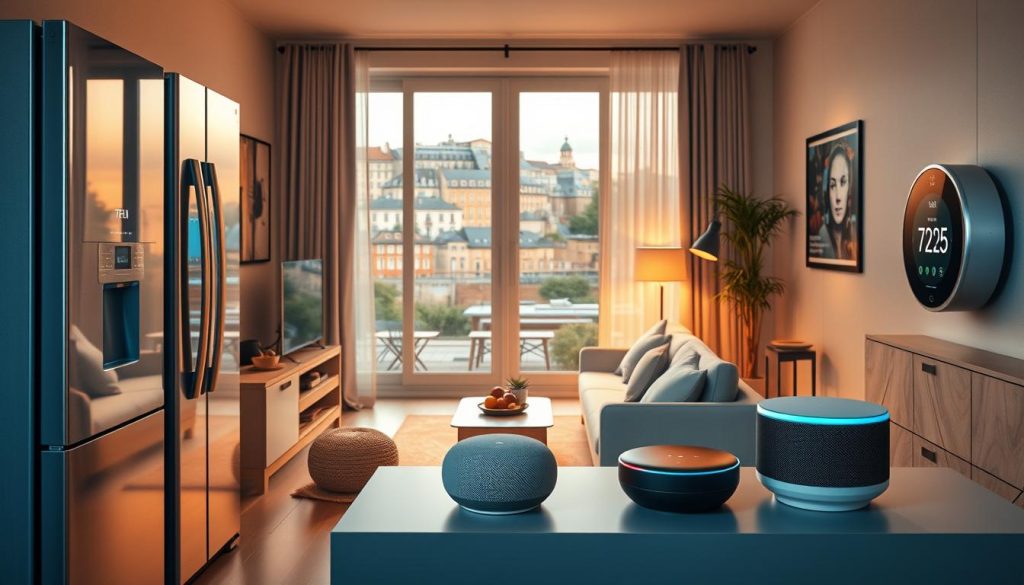
Who uses these devices matters a lot. Young people in cities like Paris are quick to adopt new tech. They like the latest gadgets and are comfortable with digital stuff.
Older homeowners, who are fixing up their homes, also buy a lot of devices. They want to make their homes safer and more energy-efficient. They see these devices as a good investment.
But, there are barriers to using more devices. Privacy is a big worry for many. They don’t want their data collected or used in ways they don’t agree with.
Devices that don’t work well together are another problem. People get frustrated with systems that are hard to use. This makes them less likely to buy more devices.
| Device Category | Adoption Rate | Primary Driver | Main Barrier |
|---|---|---|---|
| Smart Speakers | 28-32% of households | Convenience and entertainment | Privacy concerns about always-listening devices |
| Connected Thermostats | 15-18% of households | Energy cost reduction | Installation complexity and upfront cost |
| Security Cameras | 22-26% of households | Home protection and remote monitoring | Data storage and subscription costs |
| Smart Lighting | 19-23% of households | Customisation and energy efficiency | Perceived as non-essential luxury |
| Connected Appliances | 8-12% of households | Automation and convenience | High price premium over standard models |
Analysing Voice Assistant Competition and Preferences
The voice assistant market in France is very competitive. Big tech companies from abroad are up against French newcomers. Google Assistant is the biggest player, thanks to its Android connection and wide reach.
Amazon Alexa is also popular, thanks to Echo sales and Prime perks. Apple’s Siri is a hit with iPhone users but hasn’t spread much to other devices in France. The HomePod has a small market share, mainly because it’s pricey and has a limited range.
What people want from voice assistants is shaped by culture and language. How well a voice assistant speaks French matters a lot. Those that do it best get more customers.
There’s a big concern about American companies handling personal data. This has opened up a space for European and French options that focus on keeping data safe and local.
Orange, a big telecom company in France, has created Djingo. It’s a French voice assistant that’s all about privacy. It’s not as big as the others yet, but it appeals to those who care about data safety and want to support French tech.
Voice assistants are getting better and doing more things. They’re not just for simple tasks anymore. They’re getting into shopping, finance, and health. This will make more people in France want to use them.
Examining Energy Solutions and Environmental Technology
Energy management and green tech are big in France. People are very aware of the environment and the government is pushing for clean energy. This creates a lot of chances for IoT devices that help save energy and work with renewable sources.
Smart thermostats are leading the way, thanks to companies like Netatmo. They save energy and look good. They use weather forecasts and know when you’re home to adjust the heating.
Solar panel monitoring systems are growing fast. More homes in France are getting solar panels. These systems show how much energy you’re making and using, and even tell you when to clean your panels. Working with battery systems makes them even better, letting you use more of your own energy.
Home energy management systems are getting popular too. They help you find out which devices use the most energy and suggest ways to use less. They make it fun to save energy with apps that show how green you’re being.
Electric car charging is another area growing fast. As more people buy electric cars, smart charging stations become more useful. They charge your car when it’s cheapest and when there’s plenty of green energy around. Working with your home’s energy system makes it even better.
Government help makes these technologies more appealing. There are tax breaks and rebates for smart devices and special electricity rates for using energy wisely. This makes it easier for people to buy these devices.
France’s energy prices, with different rates for peak and off-peak times, encourage the use of smart devices. These devices can turn on energy-hungry appliances when it’s cheaper. This saves money without needing to change your life.
We think green tech will keep growing in France. As people become more aware of the environment and technology gets cheaper, we’ll see more devices that help save energy and work with clean energy sources. France is becoming a leader in green IoT.
Examining Agricultural Technology and Rural IoT Applications
French agriculture is seeing a big change with IoT devices. These tools help farmers make better decisions, leading to more food and less harm to the environment. With France leading in European farming, there’s a big chance for Agricultural IoT France to help all kinds of farms.
IoT tackles big challenges for French farmers. These include finding workers, dealing with changing weather, saving resources, and meeting high quality standards. Connected tech offers solutions to stay competitive and be green.
The French government supports digital farming with money and innovation hubs. This help makes new tech available to farms of all sizes.
Smart Sensors and Data-Driven Crop Management
Precision agriculture France uses sensors to watch over crops. Farmers use soil moisture sensors to water plants just when they need it. This saves water and helps plants grow better.
Drone technology is also key in French farming technology. Drones with special cameras show how healthy plants are. This helps farmers spot problems early and fix them before they get worse.
Drone data helps farmers focus on the right areas of their fields. This means no wasted effort or resources.
Weather stations give farmers local weather info. This info helps them decide when to plant, water, or spray pesticides. It’s all about making the best choices for their crops.
- Temperature fluctuations that affect planting and harvesting windows
- Rainfall measurements informing irrigation and drainage management
- Wind speeds determining optimal times for pesticide application
- Humidity levels predicting disease pressure and storage conditions
- Solar radiation influencing photosynthesis and crop development rates
GPS-guided machines help farmers work more efficiently. They follow the best paths, saving fuel and protecting the soil. This also makes sure seeds and fertiliser are spread evenly.
French farming cooperatives make new tech available to more farmers. They share costs and knowledge, helping small farms grow. Members also get to use data and advice from others in the group.
The government helps farmers buy precision agriculture France tech. They offer money to make it easier for farms to start using it.
| Agricultural Sector | Primary IoT Applications | Key Benefits | Adoption Rate |
|---|---|---|---|
| Cereal Crops | Soil sensors, GPS machinery, yield mapping | 15-25% input reduction, optimised harvesting | Medium-High |
| Livestock Operations | Health monitoring, automated feeding, location tracking | Early disease detection, improved breeding outcomes | Medium |
| Viticulture | Microclimate monitoring, fermentation control, cellar management | Quality consistency, inventory protection | High |
| Vegetable Production | Greenhouse automation, irrigation control, climate management | Extended seasons, reduced labour requirements | Medium-High |
Connected Solutions for Animal Husbandry
IoT is changing how France farms animals. Cattle, sheep, and chickens wear connected collars. These track their health and whereabouts.
IoT helps spot diseases early. This means quicker treatment and less harm to the herd. It’s a big win for farmers.
IoT also helps with breeding. It tracks when animals are ready to breed. This means better chances of successful breeding.
Automated feeding systems are another big help. They adjust food based on what each animal needs. This is good for dairy and beef farms.
These systems make feeding consistent. No more uneven feeding in groups. It’s all about what each animal needs.
IoT helps with tracking animals in big areas. GPS collars keep an eye on them. This makes it easier to find them for health checks or moving them.
Poultry farms use IoT to keep an eye on the environment. They track temperature, humidity, and air quality. This keeps birds healthy and productive.
Digital Innovation in Prestigious Wine Regions
France’s famous wine industry is using Agricultural IoT France to keep quality high. Even in famous areas like Bordeaux and Burgundy, they’re using new tech.
Vineyards use IoT to watch over their grapes. They track soil moisture, temperature, and sunlight. This helps winemakers make the best decisions.
IoT is key in Burgundy, where each vineyard is special. It helps winemakers understand and work with these differences.
Climate change is a big challenge for wine. IoT helps winemakers adapt. It gives them the info they need to make smart choices.
IoT also helps with fermentation. It keeps an eye on temperature, which affects the taste of the wine. This ensures the best quality.
Cellar management systems track storage conditions. They watch temperature, humidity, and air quality. This keeps the wine at its best.
- Temperature stability essential for proper maturation
- Humidity levels preventing cork deterioration
- Vibration detection that could disturb sediment
- Air quality preventing contamination risks
Champagne houses benefit a lot from IoT. They track conditions in their huge cellars. This keeps the wine aging perfectly.
IoT also helps with tracing wine. It uses blockchain to show where the wine came from. This fights counterfeiting and adds value to the wine.
French winemaking is a mix of old ways and new tech. This balance helps them stay competitive while keeping their wine special.
How to Navigate French IoT Regulations and Compliance Requirements
To launch IoT solutions in France, you need to understand the complex rules for connected devices. These rules cover data protection, telecommunications, and specific industry needs. Each rule has its own set of duties that shape how we design, deploy, and run IoT systems in France.
The rules for IoT regulations France go beyond just getting products certified. They also cover how you handle data, protect privacy, and keep systems secure over the device’s life. Companies that meet these French compliance requirements early on can get to market faster and avoid legal trouble.
We tackle compliance in three key steps, focusing on the main regulatory areas. This method ensures we cover everything without missing important details that could delay or cause legal issues.
Understanding GDPR Implications for IoT Data
The General Data Protection Regulation sets the base for GDPR IoT France rules. It impacts how IoT systems handle data, as they often deal with personal information. We apply these rules from the start of designing IoT systems.
Data minimisation means collecting only what’s needed. We set IoT devices to gather specific data, avoiding too much that could risk privacy. Also, we use data only for the purpose it was collected, without extra consent.
Storage limitation means keeping data only as long as needed. We set up systems to automatically delete personal info when it’s no longer needed. This is a big challenge for IoT systems that keep generating data.
For consumer IoT, getting consent is key. We make sure users clearly agree to data collection before it starts. Pre-checked boxes or implied consent don’t meet GDPR IoT France standards.
Privacy by design means making data protection a part of IoT design from the beginning. We do data protection impact assessments for high-risk projects. These assessments find privacy risks and plan how to fix them before starting.
Data protection officers are needed for big data handling tasks. We appoint experts who report directly to top management. They help guide our IoT product compliance.
Data processing agreements are key when working with cloud services or third parties. We make sure contracts outline how data will be handled, security, and breach notices. Moving data across borders needs extra protection for French user data outside the EU.
Reviewing Sector-Specific Compliance Standards
Many industries have their own French compliance requirements for IoT. We find out which rules apply early to avoid costly changes. These rules often cover safety, quality, or traceability, beyond just privacy.
Healthcare IoT must follow strict rules under the Medical Device Regulation (MDR) and In Vitro Diagnostic Regulation (IVDR). Connected medical devices and remote monitoring need assessments and ongoing checks. We work with notified bodies for certification.
Connected cars must meet safety standards through homologation. The UNECE WP.29 sets international rules, which France follows. We ensure our automotive IoT solutions meet these standards.
Agricultural IoT must track food from farm to table. The EU’s food law requires keeping records of inputs, treatments, and movements. We design solutions that automatically create compliant records.
IoT devices for payments must follow rules like the Payment Services Directive 2 (PSD2). We do security checks to show we meet banking standards.
| Industry Sector | Primary Regulation | Key Compliance Requirements | Certification Body |
|---|---|---|---|
| Healthcare | MDR/IVDR | Clinical evaluation, risk management, post-market surveillance | Notified bodies designated by ANSM |
| Automotive | UNECE WP.29 | Cybersecurity management, software update procedures, data protection | UTAC for type approval |
| Agriculture | EU Food Law (Regulation 178/2002) | Traceability records, food safety documentation, treatment logging | Ministry of Agriculture certification |
| Financial Services | PSD2 | Strong customer authentication, secure communication, transaction monitoring | ACPR (banking regulator) |
Ensuring Radio Frequency and Telecommunications Compliance
IoT devices that use wireless must follow rules on spectrum and electromagnetic safety. The CE marking shows they meet European standards. We test and document to prove they meet essential requirements.
The Radio Equipment Directive (RED) sets health and safety rules, including specific absorption rate (SAR) tests for devices near the body. We use accredited labs to check radio frequency exposure and ensure it’s safe. This is very important for wearable devices.
IoT devices must use the right spectrum bands without causing interference. The Agence Nationale des Fréquences (ANFR) manages spectrum in France. We check our devices meet these rules.
Different wireless techs have their own IoT regulations France rules. Wi-Fi and Bluetooth need to meet harmonised standards. Cellular IoT must get approval from network operators and follow 3GPP standards.
Low-power wide-area networks like LoRaWAN use unlicensed spectrum but need CE marking and follow duty cycle rules. We design our transmissions to follow these rules without harming network performance. Satellite IoT has extra rules for using international frequencies.
Electromagnetic compatibility tests check if IoT devices don’t cause too much interference or are too sensitive to outside signals. We do emissions and immunity tests to protect device function and the radio spectrum. This is key for IoT systems.
Knowing all these rules helps us manage French compliance requirements well. We avoid big compliance mistakes and get to market faster. This careful approach helps us succeed in the French IoT market.
Setting Up Your IoT Business Infrastructure in France
Creating a strong business infrastructure in France is key. It involves choosing the right company structure, financial services, and operational support. Starting an IoT business France is more than just tech—it’s about navigating admin, legal frameworks, and financial stability. Entrepreneurs face unique challenges, from complex registration to setting up banking for tech ventures.
The French market offers various paths for IoT companies. Each path has its benefits, depending on your goals, investment, and growth plans. Whether starting a smart agriculture business or expanding an IoT platform, your initial decisions are critical for success.
Choosing the Right Company Formation Structure
Choosing the right legal entity is a big decision for your IoT venture. The French company formation process has several options, each suited for different business models. Your choice affects taxes, compliance, capital needs, and flexibility.
It’s important to understand these options and how they fit your business goals. Consider factors like revenue, shareholders, capital, and future funding plans when making your decision.

The SARL (Société à Responsabilité Limitée) is like a limited liability company. It protects shareholders and has simple admin rules. It’s good for smaller IoT businesses or those preferring traditional governance.
The SAS (Société par Actions Simplifiée) is popular for tech startups and IoT ventures. It offers flexibility in governance, allowing for custom management and decision-making. SAS suits companies with single shareholders and flexible share transfers, ideal for investment.
Foreign branch establishments let international companies operate in France without a separate legal entity. This keeps your current structure while setting up in France. But, branches don’t separate liability, so the parent company is fully responsible. This option is for established companies testing the French market.
| Structure Type | Minimum Shareholders | Governance Flexibility | Best Suited For |
|---|---|---|---|
| SARL | 2-100 shareholders | Moderate – statutory requirements | Stable, smaller operations with limited shareholding |
| SAS | 1 or more shareholders | High – customisable arrangements | Tech startups, growth companies, VC-backed ventures |
| Foreign Branch | N/A (extension of parent) | Low – follows parent company rules | Market testing, temporary operations, service delivery |
| SASU (Single SAS) | 1 shareholder only | High – single decision-maker | Solo entrepreneurs, holding structures, subsidiaries |
How LerriHost Supports Company Formation (Contact: 07538341308)
LerriHost provides company formation services for IoT businesses in France. We help with the complex French admin, making it easier for international entrepreneurs. Our services ensure your business meets all requirements from the start.
We help with documents, talking to French authorities, and managing timelines. We guide you on choosing the right structure for your IoT business. Contact LerriHost at 07538341308 for tailored advice on your French company formation needs.
Establishing Banking and Payment Processing Solutions
Getting the right banking is essential for your French business. French banks need lots of documents from IoT businesses. This can take weeks, mainly for tech companies or those with international owners.
Prepare detailed documents that explain your business model and revenue. Banks look at risk carefully for tech ventures. Showing stable operations can help get approval.
Payment processing solutions let your IoT business accept payments easily. You’ll need merchant accounts for selling IoT devices or services. Modern payment systems work well with e-commerce and subscription platforms.
LerriHost helps connect IoT businesses with the right financial services. We use our tech sector knowledge to find the best banks for your needs. This speeds up the process and helps with paperwork.
Utilising Nominee Services for International Operations
International IoT companies might need local representation. Nominee services provide this by having French residents act as directors or shareholders. This ensures local compliance without losing control or ownership.
Nominee services are great for expanding into Europe. They handle admin tasks, sign documents, and talk to authorities. Strategic decisions stay with the real owners.
LerriHost offers nominee services that meet French rules while keeping your control. We ensure clear lines between admin roles and ownership. Our services include ongoing support to keep everything in order.
Accessing Financial Services for IoT Ventures
Growing IoT ventures need special financial services. Business credit facilities help with working capital for fast growth or seasonal needs. Invoice financing improves cash flow for companies with long payment terms.
Specialised lending for tech companies understands IoT business needs. Lenders look at customer acquisition costs, lifetime value, and product roadmaps. This is different from traditional businesses.
Government-backed loans offer extra funding for innovative IoT projects. The Banque Publique d’Investissement (Bpifrance) has products for tech ventures at various stages.
LerriHost connects IoT businesses with the right funding. We assess your needs, find suitable providers, and make introductions. Our IoT sector knowledge helps match you with lenders who value your business.
Understanding Connectivity Infrastructure and Network Technologies
Connectivity infrastructure is key to deploying IoT solutions in France. The choice of network technology affects device battery life, data speed, coverage, and costs. We look at the main options for IoT connectivity in France, helping you pick the right technology for your needs.
The French telecom infrastructure has grown to support various IoT projects. Different network technologies are available, each suited for specific needs. Knowing these options helps make strategic choices that balance technical needs with budget, ensuring long-term growth.
Fifth-Generation Mobile Networks Transforming Regional Connectivity
5G networks are spreading fast in France’s cities and major transport routes. Big telecoms like Orange, SFR, Bouygues Telecom, and Free Mobile have spent billions on 5G. These networks offer high-speed data over 1 Gbps, perfect for video-heavy IoT tasks like surveillance and remote inspections.
5G also brings ultra-low latency, under 10 milliseconds. This is great for real-time control in factories, self-driving cars, and remote surgeries. It can handle up to one million devices per square kilometre, ideal for smart cities.
But, 5G coverage varies across France. Big cities like Paris, Lyon, and Marseille have good coverage. But, rural areas mostly use 4G and older tech, creating a digital divide.
The 3.5 GHz band is key for French 5G. ARCEP oversees frequency use and checks if operators meet coverage goals. They must reach certain population and area percentages within set times.
Low-Power Wide-Area Networks for Extended Battery Operation
LoRaWAN is top for IoT needing long battery life and wide coverage. It uses unlicensed spectrum, cutting costs. It also goes deep into buildings and can reach up to 15 km in rural areas.
Public LoRaWAN networks by Objenious and Orange cover all of France. They save on setup costs, letting businesses quickly start projects. Private networks are for those needing their own setup for full control.
LoRaWAN is used in many ways. It’s great for smart meters and environmental monitoring. It also tracks assets and monitors soil and crops, all without often changing batteries.
LoRaWAN is not just about saving power. It’s also cheap to set up. It supports two-way communication, making updates easy. It also keeps data safe with end-to-end encryption.
Satellite Networks Enabling Ubiquitous Coverage
Satellite IoT solves connectivity issues in remote areas. It’s perfect for the Alps, rural areas, sea, and forests. It fills gaps in terrestrial networks, covering all of France.
New satellite IoT providers use LEO constellations for fast, global coverage. Kinéis, Iridium, and Globalstar support small data from sensors. They’re key for areas without cell service.
Satellite tech tracks livestock, monitors nature, and manages renewable energy. It’s also used at sea for tracking and safety. It works even when ground networks fail.
| Technology | Coverage Range | Data Rate | Power Consumption | Optimal Applications |
|---|---|---|---|---|
| 5G Networks | Urban and suburban areas | 100 Mbps – 1+ Gbps | High | Video surveillance, autonomous vehicles, real-time industrial control |
| LoRaWAN | 2-15 km radius | 0.3 – 50 kbps | Very low | Smart metering, environmental monitoring, asset tracking, agriculture |
| Satellite IoT | Global coverage | 10 – 100 bps | Moderate | Remote asset tracking, maritime applications, disaster recovery |
| 4G LTE-M | National coverage | 200 kbps – 1 Mbps | Low to moderate | Connected vehicles, wearables, mobile asset tracking |
Choosing the right connectivity tech needs careful thought. Many projects use 5G for cities, LoRaWAN for sensors, and satellite for remote areas. This mix ensures good coverage and saves costs across France.
How to Build Your IoT Company’s Digital Presence
Creating a strong IoT digital presence needs careful planning, technical skill, and the right platforms. Your website is key for French prospects to see what you offer. It shows your skills and if you’re a good partner.
Choosing the right platform and using smart strategies is key. For WordPress IoT business sites, this means using flexible systems and adding special features for your industry.
WordPress Design and Redesign for IoT Businesses
WordPress is great for IoT companies wanting a professional online base. It has lots of plugins, themes, and tools for managing content. This makes it perfect for showing off complex tech solutions.
Building a good website structure is important. It needs to meet the needs of different people. Tech experts want details, while business leaders want to see success stories and how you can save them money.
Your WordPress site should have these key things:
- Product demonstrations showing how IoT solutions work in real life
- Case studies of successful uses in French industries
- Technical documentation for those who want to know more
- Customer testimonials to show you’re trusted
- Resource libraries to show you’re a leader in your field
Standard templates don’t meet IoT business needs in France. We create custom features to make your WordPress site a powerful tool. It helps prospects find the right solutions for them, making it easier for you to find new customers.
Real-time dashboards show customers how their devices are doing. This cuts down on support calls and shows you’re always looking out for them. Secure portals let you share tech details with interested people without sharing too much.
Lead qualification systems in your WordPress site find the best prospects for you. They look at how people interact with your site, what they read, and who they are. This helps your sales team focus on the most promising leads.
Mobile-Responsive Design Requirements
More and more people look at IoT solutions on their phones. Your IoT digital presence must work well on all devices. Responsive design makes sure your site looks good on any screen size.
We test your site on many devices to make sure it works well. We use special techniques to make it fast on phones, like compressing images and making sure it’s easy to navigate with your finger.
How fast your site loads is very important. Mobile users expect it to be quick. If it’s slow, they might leave your site without looking at anything else.
Implementing SEO for WordPress to Reach French Markets
To be seen in French searches, you need good SEO. LerriHost knows how to make your WordPress site rank well. We use technical tweaks and content that answers questions.
We make sure your site is easy for search engines to find. This includes making your titles and descriptions good, using the right tags, and linking well. We also work on your site’s speed and mobile-friendliness.
| SEO Component | Implementation Priority | Expected Impact | Timeline |
|---|---|---|---|
| Technical Optimisation | Critical | Foundation for all SEO efforts | 2-4 weeks |
| Keyword Research | Critical | Targets French market search behaviour | 1-2 weeks |
| Content Strategy | High | Addresses buyer questions and concerns | Ongoing |
| Link Building | Medium | Establishes domain authority | 3-6 months |
Our content strategies for French market SEO create resources that answer questions. We write blog posts, guides, and case studies. We also build links from trusted sources to boost your site’s authority.
Ensuring Reliable WordPress Web Hosting
Having a site that’s always up is key. LerriHost offers WordPress web hosting that’s fast, secure, and reliable. Our setup is made just for WordPress sites, so it works best.
We have hosting options for all sizes of businesses. Small startups can use shared hosting, while big companies need dedicated servers. We also offer managed hosting, so you can focus on growing your business.
Our hosting includes fast content delivery networks for French visitors, automatic backups, and protection against attacks. This keeps your site running smoothly.
Maintaining Your Digital Assets with WordPress Maintenance Services
Your site needs regular care to stay secure and fast. LerriHost’s WordPress maintenance services keep your site in top shape. We update your site regularly to keep it safe from hackers.
We watch your site for any suspicious activity and fix problems fast. We also make sure you have recent backups, so you can quickly get back to normal if something goes wrong. And we make your site run smoothly, so visitors have a good experience.
Our maintenance services include help from experts who know IoT businesses. They can quickly solve any problems you have, so you can focus on your business.
Contact LerriHost at 07538341308 for Complete WordPress Solutions
LerriHost offers everything you need for a strong online presence in France. We help with WordPress design, SEO, hosting, and maintenance. We make sure your site is always up and running well.
We create custom WordPress sites for IoT businesses, adding special features that set you apart. Our SEO services help French people find you when they search for IoT solutions. And our hosting and maintenance services keep your site fast and secure.
Call LerriHost at 07538341308 to see how we can help your IoT business grow in France. We understand the challenges you face and offer tailored solutions to help you succeed.
Identifying Investment Opportunities and Funding in the France IoT Ecosystem
France is committed to digital innovation, creating a strong funding landscape for IoT ventures. Getting the right capital is key to turning innovative ideas into real solutions. The French ecosystem offers many funding paths, including public support, private investment, and European funding.
Knowing about these funding sources helps entrepreneurs plan their funding needs. France’s technology funding has grown a lot in recent years. This shows the country’s focus on digitalisation and tech sovereignty.
Government Grants and Innovation Programmes
Bpifrance is the main source of government-backed funding for IoT ventures in France. It offers grants, subsidised loans, and equity investments for tech companies at different stages. Bpifrance’s programmes focus on digital transformation, making them great for IoT investment in France.
To apply, you need a detailed business plan and technical studies. You must show how your IoT solution meets market needs and supports France’s digital economy goals.
French Tech is another government-backed initiative that supports IoT ventures. It offers accelerators, networking, and promotional support. Getting French Tech certification can help when looking for private funding.

There are sector-specific innovation programmes for IoT. These programmes support:
- Industrial digitalisation initiatives – funding for manufacturing automation and Industry 4.0 implementations
- Agricultural technology development – grants for precision agriculture and farm management systems
- Healthcare innovation schemes – support for connected medical devices and telemedicine platforms
- Smart city development funds – municipal-level programmes for urban IoT deployments
To succeed with public funding, understand the eligibility criteria and show innovation. Align your project with government priorities. Working with Bpifrance advisors early can help meet all requirements.
Private Equity and Venture Capital Landscape
France’s venture capital scene has grown a lot. Many firms look for IoT venture capital in France. Big French investment firms like Partech, Elaia Partners, and Serena Capital focus on IoT. International firms like Accel and Index Ventures also invest in France, bringing global networks.
IoT ventures need more time to develop than software companies. Seed funding is usually €500,000 to €2 million for early stages. Series A rounds are €3 million to €10 million for market entry and scaling.
Investors look at several key factors for IoT ventures. These include business model scalability, intellectual property, management team, and market access. We consider these essential for private funding.
| Investment Criteria | Investor Expectations | Strategic Considerations |
|---|---|---|
| Business Model Scalability | Clear path to recurring revenue and international expansion | Demonstrate unit economics and customer acquisition strategy |
| Intellectual Property | Defensible technology advantages through patents or proprietary methods | Document innovation and competitive differentiation |
| Management Team | Experienced leadership with relevant industry knowledge and execution capability | Highlight team expertise and advisory board strength |
| Market Access | Established customer relationships and clear routes to market penetration | Present pilot projects and partnership agreements |
Corporate venture capital arms of major French tech and industrial companies are also a funding source. Companies like Orange Digital Ventures, Schneider Electric Energy Access, and Total Carbon Neutrality Ventures invest in IoT innovations. They offer capital, market access, technical expertise, and acquisition pathways.
Valuations for IoT companies have become more complex. Early-stage companies can expect valuations between €3 million and €8 million at seed stage. Later-stage valuations reflect revenue multiples and growth trajectories, similar to other European tech markets.
European Union Funding Mechanisms
European funding programmes offer resources for IoT projects addressing EU-wide challenges or involving cross-border collaboration. Horizon Europe, the EU’s flagship research and innovation programme, has a budget over €95 billion for 2021-2027. It funds digital technology projects, including IoT.
The Digital Europe Programme focuses on building digital capacities across member states. It has funding for artificial intelligence, cybersecurity, and advanced digital skills, all relevant to IoT ecosystem development. French companies can access these funds through competitive applications that reward innovation and collaboration.
The European Innovation Council supports breakthrough innovations through its Pathfinder, Transition, and Accelerator programmes. IoT ventures can get grants and equity investments from €500,000 to €15 million. Successful applications often involve partnerships across multiple EU member states, improving funding chances and market reach.
To access EU funding, you must navigate complex application procedures and show alignment with European strategic priorities. Working with experienced grant consultants or using enterprise Europe network resources can help. Combining EU grants with private investment is a strong strategy for ambitious IoT ventures aiming for rapid scaling across European markets.
This overview helps IoT entrepreneurs find the right funding sources for their growth ambitions, development stage, and strategic objectives in France’s supportive innovation ecosystem.
How to Address Cybersecurity in French IoT Deployments
Cybersecurity is key for successful IoT in France. IoT systems have many entry points for attacks. So, strong security is a must, not just a choice.
IoT security is different from traditional IT security. Devices often work in tough environments and can’t always protect themselves. We need special security plans that work with these challenges and follow French rules.
Recognising Common IoT Security Vulnerabilities
First, we need to spot the common attack points. Default or weak passwords are a big problem. Many devices come with easy-to-guess passwords that users don’t change.
Old firmware is another big risk. IoT devices often don’t update automatically. This means they can stay vulnerable for a long time.
IoT devices often send data without encryption. This makes it easy for hackers to listen in or send bad commands. It’s a big risk when devices talk over public networks.
Some IoT systems give too much access. This is because they don’t control who can do what. If one account gets hacked, it can open up a whole network to danger.
Devices in easy-to-reach places often don’t get enough protection. Many focus on digital security but forget about physical risks. Hackers can get into devices and steal data or change how they work.
| Vulnerability Type | Attack Vector | Potential Impact | Mitigation Priority |
|---|---|---|---|
| Default Credentials | Automated scanning and brute force attacks | Complete device compromise and network access | Critical |
| Outdated Firmware | Exploitation of known security flaws | Remote code execution and data theft | High |
| Unencrypted Communications | Man-in-the-middle attacks and eavesdropping | Data interception and command injection | Critical |
| Inadequate Access Controls | Credential theft and privilege escalation | Unauthorised system modifications | High |
| Physical Tampering | Direct device manipulation | Hardware compromise and data extraction | Medium |
Implementing Device Authentication and Encryption
Strong authentication is the first line of defence. We use certificate-based authentication for better security. It makes sure devices and platforms can trust each other.
Adding multi-factor authentication to management interfaces is key. It makes sure only the right people can get in. This is important when passwords get stolen.
Secure bootstrapping is important for device setup. It makes sure devices and platforms are secure from the start. This involves using special certificates or keys during manufacturing.
Encryption is needed for many parts of IoT. Transport Layer Security (TLS) keeps data safe when it’s being sent. We use the latest versions and strong ciphers to avoid old, weak ones.
Encryption is also needed for data stored on devices. Even if hackers get physical access, encrypted data is safe. We encrypt things like sensor data and personal info.
End-to-end encryption is the best way to protect sensitive data. It keeps data safe from start to finish. Only the right people can see it in plain text.
Managing cryptographic keys is a big challenge for IoT. We need good systems for making, sharing, and changing keys. Using hardware security modules helps keep keys safe from hackers.
Compliance with French Cybersecurity Agency (ANSSI) Guidelines
ANSSI gives detailed advice on IoT security. We follow their rules for connected objects security. They cover what’s needed for IoT in different areas.
ANSSI also has rules for network security. They say how to keep IoT communications safe. We make sure our networks are secure and can’t be easily broken into.
Certification shows we meet security standards. The CSPN (Certification de Sécurité de Premier Niveau) is for basic security. It means our products are checked and meet basic security needs.
For critical areas, we get higher certifications. These are more detailed and show our products are very secure. They are recognized worldwide.
When there’s a security problem, we have to tell people and the authorities. We follow GDPR and French laws to do this. We have plans for dealing with security issues quickly.
Keeping an eye on security is ongoing. We test for threats, do regular checks, and update security fast. ANSSI wants us to be proactive, not just react to problems.
We keep detailed records of our security efforts. This helps us prove we’re following the rules and shows how we keep things secure. It’s important for audits and improving security.
By following these steps, we keep IoT safe and meet French rules. Security is part of everything we do, from design to ongoing use. This protects our customers and keeps us competitive in the French market.
Preparing for Future Trends Shaping the France IoT Landscape
We must get ready for new technologies that will change the IoT in France. The Future IoT France is changing fast, thanks to new computing, sustainability, and data processing breakthroughs. Knowing these trends helps businesses stay ahead in France.
France is all about tech innovation, making it a great place for next-gen IoT. There’s a lot of money going into research and real-world projects. This shows France wants to stay at the top in digital change.
Artificial Intelligence and Edge Computing Integration
AI and edge computing are changing how IoT works in France. Instead of just using cloud computing, we’re seeing distributed intelligence getting closer to data sources. This makes things faster, uses less bandwidth, and keeps data safer.
French companies are using edge AI for quick decisions without needing the cloud. For example, quality checks on production lines can spot problems right away. Self-driving cars make fast decisions based on local data, not cloud delays.
Edge computing is changing many areas in France. Smart buildings adjust to how many people are there. Shops can understand customer behaviour without sending data to the cloud.
Places like INRIA and CEA-Leti are pushing edge AI forward. They’re working on low-power chips and smart algorithms. French chip makers are making special chips for edge AI, making France a leader in hardware.
Sustainability and Green IoT Initiatives
France is leading in green IoT, thanks to its focus on the environment. IoT is being used to cut down on waste and save energy. Systems watch how much energy is used and adjust it to save more.
IoT is helping the circular economy too. Sensors track products to help them last longer. When products need to be recycled, IoT makes it easier.
Precision farming is another area where IoT is making a big difference. It helps farmers use less water and fertiliser. This reduces harm to the environment.
Smart grids are also important. They use IoT to manage energy from solar and wind. This makes the grid more efficient and reliable.
There’s a big push for sustainable IoT devices too. Companies are choosing parts that use less energy and can be recycled. France is supporting this with laws and incentives.
Quantum Computing’s Future Impact
Quantum computing is a big deal for France’s future. The country is investing a lot in research. Places like CNRS and Pasqal are making progress in quantum tech.
When quantum computing meets IoT, it could change how we process data. It could solve complex problems much faster. This could help with supply chains, traffic, and energy.
But, there are security concerns with quantum computing. Current encryption might not be safe against quantum attacks. IoT devices need to be secure for a long time.
French researchers are working on new encryption for IoT. They’re making algorithms that are safe for devices with limited power. Agencies like ANSSI are helping with security advice.
Digital Twin Technology Adoption
Digital twins are becoming more common in France. They’re virtual copies of real things, updated with IoT data. This technology is changing many fields, like manufacturing and healthcare.
Manufacturers use digital twins to test production lines before making changes. This saves time and money. It helps find the best way to make things.
Urban planners use digital twins to try out new city designs. They can see how traffic and services will change. This helps make better decisions.
In healthcare, digital twins help plan treatments. Doctors can see how a treatment will work for a patient. This makes treatments more effective.
Companies like Dassault Systèmes are leading in digital twin tech. Research is making these systems even better. This is how France is leading in IoT innovation.
| Technology Trend | Implementation Timeline | Primary Applications | Investment Priority |
|---|---|---|---|
| Edge AI Computing | Currently Deploying | Autonomous vehicles, industrial automation, smart buildings | High – immediate ROI |
| Green IoT Solutions | Accelerating Adoption | Energy management, circular economy, precision agriculture | High – regulatory drivers |
| Quantum-Safe Security | Early Implementation | Critical infrastructure, long-lifecycle devices, financial systems | Medium – future proofing |
| Digital Twin Systems | Mainstream Adoption | Manufacturing optimisation, urban planning, personalised healthcare | High – competitive advantage |
Knowing about these French technology trends helps businesses make smart choices. Keep up with new tech through research and industry events. Adopting new tech early can give you an edge, but make sure it’s worth it.
The mix of AI, green tech, quantum computing, and digital twins offers big chances. Companies that use these well will lead in IoT innovation. France’s strong research, laws, and investment make it a great place for these advancements.
Taking Action in the French IoT Market
The France IoT opportunities we’ve looked at show great chances for businesses. They can dive into sectors like manufacturing, smart cities, and healthcare. To enter the French IoT market, you need a solid plan and the right support.
Success in IoT business France means knowing the rules, setting up your business right, and having a strong online presence. The tips we’ve given are a good start for making smart choices in different areas.
Make sure to follow GDPR and ANSSI rules. Also, team up with local tech companies. Your strategy should fit France’s business culture and what its people like, not just copy others.
LerriHost is here to help you in France. We can guide you on setting up your business, finding banking solutions, and more. Our services also boost your online presence.
Our team knows the hurdles IoT businesses face in France. We offer custom advice for your tech and business needs.
Call LerriHost at 07538341308 to talk about how we can help. The steps and ideas in this guide can lead to real success in France’s tech world. Start planning wisely and take action with the right partners.